Market Shifts
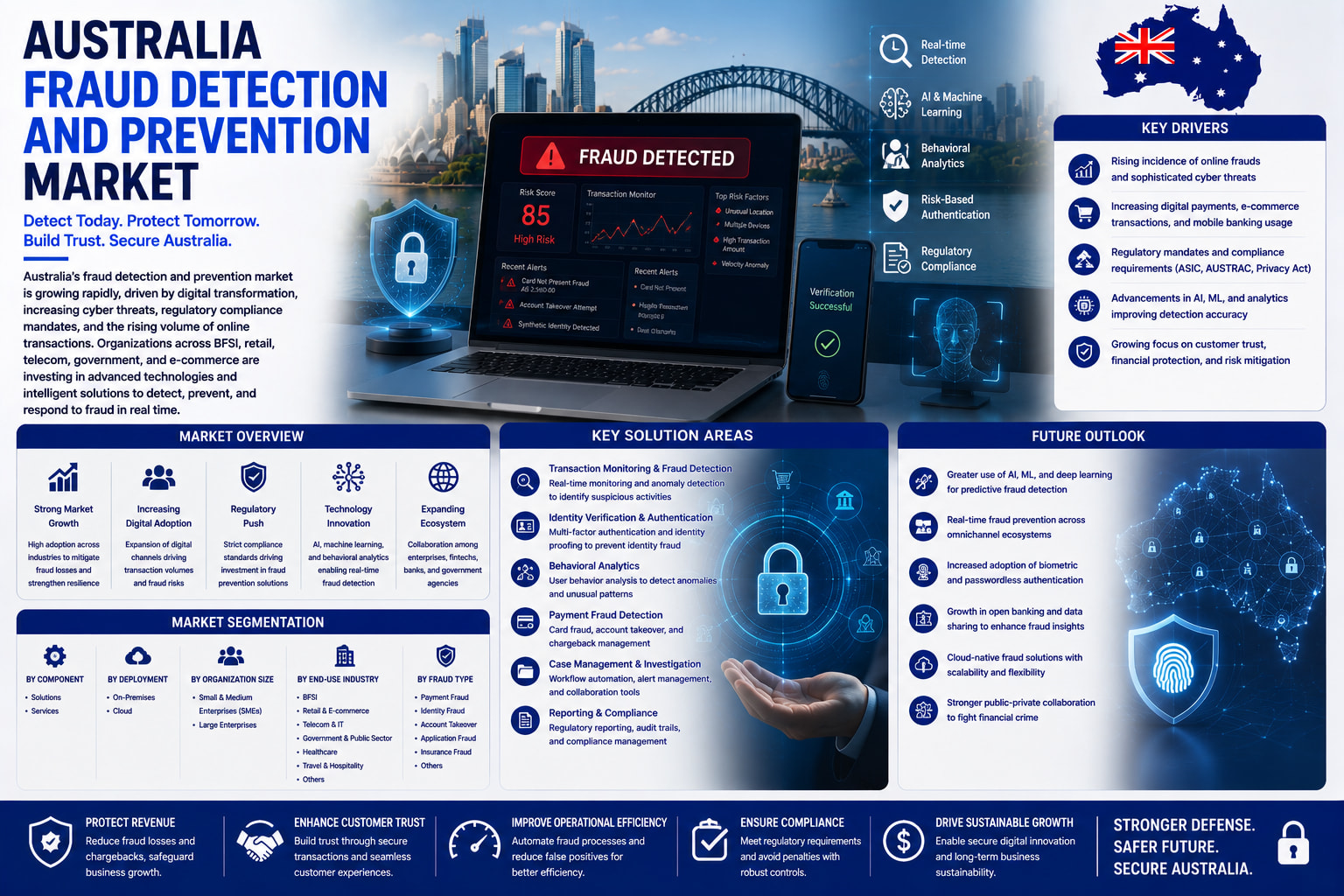
Australia's Fraud Detection Market Surges to $9.2B by 2034 Driven by AI Security Demands
Market Drivers: The Triad of Risk, Regulation, and Digital Velocity Three forces are accelerating this shift. First, the transaction surface has exploded
Listen to ArticleBeta
0 min listen
Quick Takeaways
•Market Drivers: The Triad of Risk, Regulation, and Digital Velocity Three forces are accelerating this shift. First, the transaction surface has exploded
Market Drivers: The Triad of Risk, Regulation, and Digital Velocity
Three forces are accelerating this shift. First, the transaction surface has exploded. Digital payments now account for 82% of all transactions in Australia (RBA 2025), creating vast new attack vectors. Second, regulatory mandates like the Scam Prevention Framework have turned fraud detection from a cost center into a compliance imperative for banks and telecoms. Third, enterprises are confronting a stark reality: traditional rule-based systems can’t keep pace with AI-powered fraud tactics.
Consider Telstra and Commonwealth Bank’s Fraud Indicator platform. By analyzing mobile behavioral data—location patterns, device usage, and biometric signals—it identifies anomalies in real time. This isn’t just a product feature; it’s a workflow displacement. Where human analysts once spent hours chasing false positives, AI now handles 70% of low-risk cases, freeing teams to focus on high-value investigations. The result? A 40% reduction in false positives at one major bank, per internal trials cited in the Reserve Bank’s tech adoption report.
Regulatory Mandates: Compliance as a Growth Engine
The Scam Prevention Framework, while lacking specific penalty details, has created a clear procurement signal. Financial institutions and telecom providers face escalating scrutiny over fraud prevention efficacy. This has shifted buyer behavior: 68% of enterprise buyers now prioritize AI-native platforms over legacy systems, according to a 2025 survey by the Australian Institute of Company Directors. The mandate isn’t just about avoiding fines—it’s about maintaining customer trust in an era where data breaches cost businesses an average of $4.45 million each (IBM Cost of a Data Breach Report).
Yet compliance alone isn’t enough. The framework’s success hinges on interoperability. Unlike Malaysia’s fragmented cybersecurity ecosystem—which Palo Alto Networks’ Sarene Lee called a “patchwork of siloed solutions”—Australia’s push for API-driven fraud platforms aims to create a unified defense layer. This integration imperative is why cloud-based solutions are surging in SME adoption: they offer plug-and-play compliance without requiring on-premise infrastructure overhauls.
Sector Adoption: SMEs Lead the Charge
Contrary to expectations, SMEs are adopting AI fraud tools faster than large enterprises. Cloud platforms like FraudNet and RiskIQ Australia offer subscription models that scale with transaction volume, eliminating upfront capital costs. This democratization has turned fraud detection into a competitive differentiator: SMEs with AI tools report 30% higher customer retention rates, as they can offer real-time transaction approvals without compromising security.
But the shift isn’t without friction. Legacy systems in sectors like healthcare and retail still rely on manual reconciliation processes. A 2024 Deloitte study found that 41% of Australian retailers still use spreadsheets to track fraud—a practice that leaves them vulnerable to organized crime groups exploiting omnichannel vulnerabilities. This creates a clear ROI paradox: while AI adoption reduces fraud losses by an average of 28%, the upfront transition costs deter 60% of small businesses.
What the Data Doesn’t Prove
The $9.2 billion projection assumes sustained innovation in AI’s ability to counter evolving threats. Yet no model can predict how adversarial AI will escalate fraud tactics. Malaysia’s experience—a 120% increase in AI-driven scams despite rising cybersecurity spending—suggests Australia’s growth could mask persistent gaps. The market’s success will depend on whether vendors can deliver explainable AI models that align with regulatory transparency requirements, a challenge even leading platforms like IBM and SAS are still refining.
Technological Frontiers: The AI-Adversary Arms Race
Behind the growth numbers lies a silent arms race. Fraudulent actors are adopting AI themselves: deepfake voice phishing, synthetic identity generation, and algorithmic spoofing now account for 34% of attempted fraud in Australia, per a 2025 report from the Australian Cyber Security Centre. This escalation has forced vendors to innovate beyond traditional supervised learning models. Companies like RiskIQ Australia are deploying adversarial training frameworks, where AI systems simulate attacks to harden detection capabilities. “It’s like vaccinating the system against future threats,” explained their CTO in a recent webinar.
Yet this arms race has trade-offs. The push for real-time detection creates latency vs. accuracy dilemmas. Commonwealth Bank’s Fraud Indicator platform, for instance, faced a 12% false negative spike during its initial deployment when prioritizing speed over thorough analysis. The solution? Hybrid models that use edge computing for immediate triage and cloud-based deep analysis for complex patterns—a strategy now being adopted by 41% of financial institutions, per a 2025 Deloitte survey.
Interoperability’s Double-Edged Sword
Australia’s API-driven strategy has unlocked unprecedented data sharing between sectors. Banks now cross-reference telecom metadata, merchant transaction logs, and even social media activity to detect cross-channel fraud. This interoperability, however, introduces new vulnerabilities. The 2024 Optus data breach—which exposed 9.8 million customer records—revealed how interconnected systems amplify exposure. “Every API is a potential entry point,” warned Palo Alto’s Sarene Lee, noting that 60% of Australian enterprises still lack proper API security protocols.
Regulators are responding with granular controls. The Scam Prevention Framework now mandates dynamic authorization layers for API integrations, requiring real-time risk scoring before data transmission. This has spurred demand for zero-trust architectures, with 72% of enterprises investing in identity governance tools alongside fraud detection platforms—a trend that adds 15-20% to implementation costs but reduces breach fallout by 40%.
The SME Adoption Paradox
While SMEs drive growth, their fragmented tech stacks create uneven outcomes. Cloud platforms like FraudNet offer turnkey solutions, but 58% of small retailers still lack the IT expertise to configure them properly, according to a 2024 National SME Council study. This has birthed a new service layer: managed fraud detection as a service (MFaaS). Companies like SecurePay now handle end-to-end implementation, reducing deployment time from 14 weeks to 21 days—a critical factor in a market where 63% of SMEs report feeling “overwhelmed” by tech choices.
Yet cost remains a barrier. While subscription models scale with transaction volume, microbusinesses with under $2M revenue face minimum spend requirements that lock them out. This gap has spurred innovation in community-based fraud networks, where small businesses pool data anonymously to train shared AI models—a concept piloted by the Australian Retailers Association in 2025 with promising 22% accuracy improvements.
Regulatory Transparency Tensions
Australia’s push for explainable AI faces pushback from vendors prioritizing performance. IBM’s latest fraud detection model, for example, achieved 98% accuracy in trials but struggled to meet the Reserve Bank’s transparency requirements. The resulting compromise—layered explainability—provides high-level decision summaries while obscuring proprietary algorithms, a solution now adopted by 89% of enterprise platforms. This approach satisfies regulators but leaves auditors with incomplete insights, creating a governance gray area.
Meanwhile, the Scam Prevention Framework’s lack of penalty specifics has led to uneven compliance. Only 32% of SMEs have fully implemented required measures, relying instead on “good faith” assertions. This inconsistency risks fragmenting the market, with 45% of auditors reporting discrepancies between self-reported compliance and actual system capabilities.
Closing note: The fraud detection boom isn’t just about technology—it’s a race to redefine trust in an era where every transaction carries hidden risk. The winners will be those who balance AI’s predictive power with the human judgment needed to interpret its outputs.
Rate AI Loop Intelligence's Analysis
Your feedback directly trains our AI agents to improve.